Loading…

Audio to Banjo MIDI
Turn rapid-fire 5-string bluegrass rolls, clawhammer frailing patterns, and Irish tenor banjo tunes into editable MIDI. Upload an MP3, WAV, M4A, or FLAC, keep banjo selected so dreadnought guitars, mandolin chops, and upright bass stay masked out, inspect every thumb-index-middle pluck on the piano roll, and bring the .mid into your DAW.
Hear the membrane snap, see every 3-finger banjo roll on the grid
Play your recording beside the piano roll. Fast eight-note Scruggs forward-reverse rolls, high G5 fifth-string drone hits, and hammer-on/pull-off bursts separate cleanly because each metal-pick transient snaps with zero mud.
Reading the MIDI…
Banjo MIDI engineered for membrane-head transients and 5th-string drones
Banjo-only hard mask away from acoustic guitar, mandolin, and fiddle
Launching Audio to MIDI here locks in the banjo hard mask. Boom-chuck dreadnought guitar strums, off-beat mandolin chops, and walking upright bass lines are kept out so your MIDI clip traces only the banjo.
Untangles rapid Scruggs 3-finger rolls and the high re-entrant 5th string
On a 5-string banjo, the thumb repeatedly plucks a short, high-pitched 5th string (usually G4/G5) right alongside lower melody notes played by the index and middle fingers. The piano roll shows exact sounding pitches so intertwined roll patterns never get confused with standard guitar arpeggios.
Unquantized .mid ready for bluegrass & Americana sample libraries
History gives you the unquantized transcription MIDI first, preserving the driving front-of-the-beat bluegrass bounce or syncopated clawhammer drop-thumb timing. Drop it onto Impact Soundworks, Orange Tree Samples, or Kontakt banjo patches in Logic, Ableton, or Pro Tools.
Distinct from steel-string acoustic guitar and shamisen
A Mylar or skin drumhead paired with a brass tone ring gives the banjo a razor-sharp 2–5 kHz pluck transient with quick decay—completely different from the warm wooden sustain of an acoustic guitar or the fretless bachi slap of a shamisen.
How to turn a banjo recording into MIDI
Four steps from a bluegrass breakdown or folk stem to an editable .mid file.
- 1
Upload up to 10 minutes of banjo audio
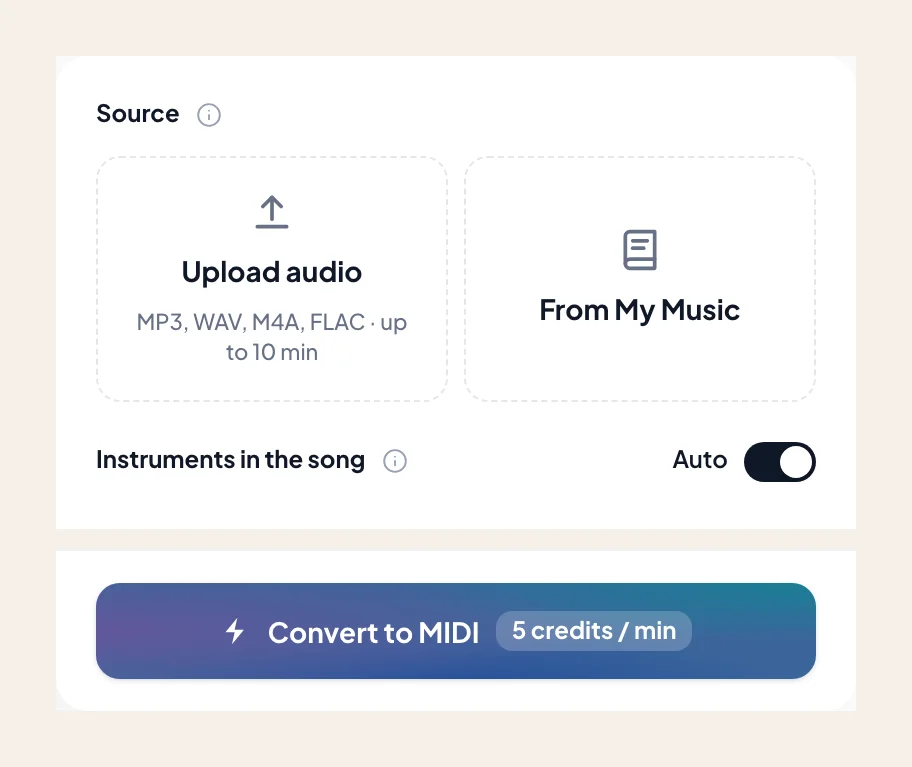
Drop an MP3, WAV, M4A, or FLAC — a 160-BPM Scruggs breakdown, an old-time clawhammer solo, or a 4-string Irish tenor banjo reel. Or pick a track from My Music.
- 2
Keep banjo preselected
Banjo is preselected on this landing. Leave it solo so acoustic rhythm guitars or fiddles in the bluegrass circle don't spill into your roll.
- 3
Inspect roll patterns and high-G drone hits on the piano roll
Scrub the roll against the original audio to check 2-to-3 fret slides, pull-offs, and repeated high-drone thumb ticks before export.
- 4
Download .mid and drop into your DAW
Import the .mid into Logic, Cubase, Ableton, or FL Studio to drive virtual banjo libraries, study the roll geometry, or rearrange the picking pattern.
Banjo MIDI output for Americana producers and pickers
Download the verified .mid straight into your session. Need printable 5-string banjo tablature or standard notation? Visit the Audio to Sheet Music banjo page.
- 01
Unquantized Transcription MIDI (.mid)
Captures sixteen-note three-finger rolls, melodic-style Keith scale runs, and clawhammer brush-thumb grooves with their natural drive intact.
- 02
Works with Kontakt Banjo Libraries & Standard MIDI DAWs
Load straight into Logic, Pro Tools, Ableton, Reaper, or FL Studio regardless of whether the source used Open G (gDGBD), Double C, or Irish GDAE tuning.
Tips for crystal-clear banjo MIDI transcription
Banjo notes pop off a drumhead fast, which is great for onset detection—here is how to get the best roll.
No need to guess Open G, Double C, or capoed tunings first
Whether the player tuned to standard Open G (gDGBD), sawmill (gDGCD), or spiked the 5th string up to A or B with a capo, the MIDI file writes the exact concert pitches heard on the recording.
Separate dense bluegrass ensemble breaks with Stem Splitter
When mandolin tremolos and flatpicked acoustic guitar trade licks right on top of the banjo roll, run Stem Splitter first so only the membrane-head plucks hit the transcriber.
Trim short Fret-2-to-3 slide grace notes for sampler keyswitches
Classic bluegrass slides (like 2nd to 3rd fret on the B string) transcribe as a quick pick-up note into the target pitch. In your DAW, you can trigger your banjo plugin's dedicated slide articulation on those beats.
Bluegrass pickers and country producers using banjo MIDI
“Trying to figure out whether a fast melodic-style run used the open 5th string or a fretted 2nd string at 150 BPM used to take me hours of half-speed looping. The piano roll laid out every single thumb and finger hit.”
“We needed a driving banjo arpeggio bed under a modern country-pop chorus, so I converted an acoustic reference scratch track to MIDI and triggered our Kontakt banjo library in Pro Tools.”
“Even on an old-time clawhammer recording in Double C tuning, the hard mask ignored the stomp box and fiddle and captured the exact bum-ditty drop-thumb rhythm.”
More plucked string and folk instruments as MIDI
Explore guitars, lutes, and folk strings — each page opens Audio to MIDI with that instrument preselected.

Sitar
Convert a song or MP3 to sitar MIDI online. Separate plucked baj-tar melodies and wide meend bends from taraf shimmer and chikari drones into a DAW .mid.

Koto
Convert audio or MP3 to koto MIDI online. Capture 13-string Japanese zither pentatonic glissandi, tsume pick plucks, and oshi-de pitch presses as a DAW .mid.
Shamisen
Convert a song or MP3 to shamisen MIDI online. Capture 3-string fretless Japanese lute melodies, percussive bachi skin slaps, and Tsugaru rock riffs as a .mid.
Frequently asked questions
Does Audio to Banjo MIDI give accurate results?
How do I use Audio to Banjo MIDI?
How does the high 5th drone string on a 5-string banjo appear in the MIDI file?
Does this work for Scruggs 3-finger style, clawhammer, and 4-string Irish tenor banjo?
Why should I use the Banjo page instead of the Acoustic Guitar MIDI page?
Do I have to tell the tool if the banjo had a capo or 5th-string spikes?
Where can I get printable 5-string banjo tabs or sheet music?
Can I try Audio to Banjo MIDI for free?
What do I get after conversion?
Can I open the result in my music software?
Can I use the result in my own projects and commercially?
What files can I upload?
How do I get the best result from Audio to Banjo MIDI?

Convert your banjo audio into editable MIDI
Upload your 5-string roll or tenor banjo track, keep banjo selected, and download a .mid for your DAW.