Loading…
Song to Shamisen MIDI
Turn hard-hitting Tsugaru shamisen solos, traditional nagauta lines, and high-energy anime rock riffs into editable MIDI. Upload an MP3, WAV, M4A, or FLAC, keep shamisen selected so taiko drums, distorted guitars, and shakuhachi leads stay masked out, inspect bachi strikes and fretless slides on the piano roll, and drop the .mid into your DAW.
Hear the bachi snap on the skin head, verify the shamisen MIDI on the roll
Play your recording beside the piano roll. Percussive bachi downstrokes (tataki), left-hand finger pulls (hajiki), open-string sawari buzz drones, and rapid fretless neck slides line up beat for beat before you export.
Reading the MIDI…
Shamisen MIDI built for percussive bachi transients and fretless slides
Shamisen-only hard mask through taiko drums and J-rock mixes
Opening Audio to MIDI from this page locks in the shamisen hard mask. Booming taiko percussion, overdriven electric rhythm guitars, and vocal shouts (kakegoe) are filtered out so only the 3-string lute writes to your MIDI clip.
Distinguishes pitched string plucks from percussive skin-head slaps (tataki)
When a player strikes a shamisen with a wide ginkgo-leaf bachi plectrum, the blade simultaneously snaps the silk/nylon string and slaps the stretched dog- or synthetic-skin soundbox. The transcription locks onto the true string pitch rather than misfiring on the unpitched drumhead thud.
Tracks fretless finger slides (suri), hajiki pull-offs, and sawari resonance
With a smooth fretless fingerboard and an intentional nut buzz (sawari) on the lowest string, shamisen lines move through snappy left-hand hammer-ons (uchi) and rapid neck slides. The unquantized piano roll captures every fast attack and slide contour.
Distinct from 13-string koto and 5-string bluegrass banjo
Unlike a koto zither with long wooden sustain or a fretted 5-string American banjo playing three-finger arpeggio rolls, shamisen uses three heavy strings tuned in fourths/fifths (Honchōshi, Niagari, Sansagari) with aggressive bachi down-and-up strokes (sukui).
How to convert a song into shamisen MIDI
Four steps from a Tsugaru solo or anime battle track to an editable .mid file.
- 1
Upload up to 10 minutes of shamisen audio
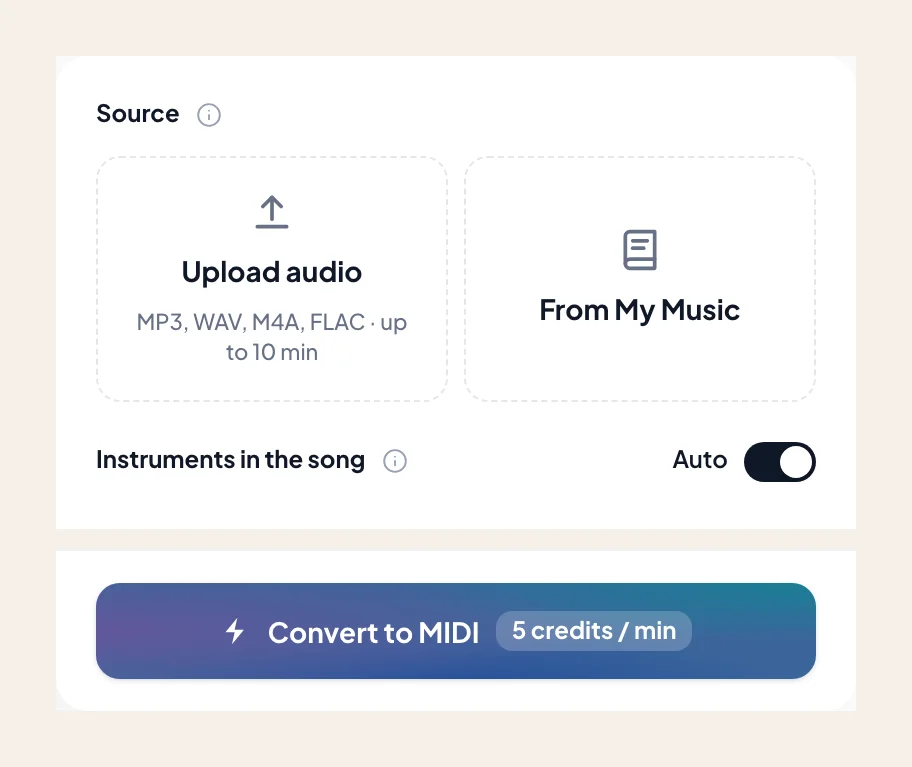
Drop an MP3, WAV, M4A, or FLAC — a virtuosic Tsugaru improvisation, a min'yō folk song, or a modern J-rock/anime track driven by shamisen riffs. Or select a track from My Music.
- 2
Keep shamisen selected
Shamisen is preselected on this landing. Leave it isolated so taiko drums, bass, or koto parts don't mix into your lead clip.
- 3
Audit fast bachi tremolos and fretless slides on the piano roll
Scrub the roll against the original audio to check rapid down-up bachi alternations (kamashi), open-string drone hits, and neck slides before exporting.
- 4
Download .mid and drive your shamisen library or rock arrangement
Import the .mid into Logic, Cubase, Ableton, or FL Studio to trigger virtual shamisen patches, double the riff with electric guitar or synth bass, or study the phrasing.
Shamisen MIDI exports for anime, game, and world-fusion producers
Download the unquantized .mid straight into your DAW. If you want printable Western staff notation instead of traditional bunkafu 3-line number notation, visit the Audio to Sheet Music shamisen page.
- 01
Unquantized Transcription MIDI (.mid)
Preserves the explosive rhythmic drive, syncopated hajiki pull-offs, and micro-timed bachi accents of a live Tsugaru performance.
- 02
Ready for Impact Soundworks, Premier Sound Factory & Kontakt
Load into any Standard MIDI DAW in true concert pitch—no need to translate Honchōshi, Niagari, or Sansagari relative tuning charts.
Tips for sharper shamisen MIDI from solo and ensemble tracks
Tsugaru shamisen is half melodic lute and half percussion instrument—here is how to get the cleanest roll.
No need to calculate Honchōshi (1-4-1), Niagari (1-5-1), or Sansagari tunings
Shamisen players constantly re-tune the three strings to match a singer's vocal range and switch between fourths and fifths. Audio to MIDI always writes the exact sounding concert pitches directly onto the piano roll.
Isolate shamisen from distorted electric guitar in anime/J-rock mixes
In modern Japanese rock and game soundtracks, shamisen and overdriven electric guitar often double the exact same pentatonic riff. Run Stem Splitter first so guitar power chords don't double up on your shamisen roll.
Use high-velocity hits to trigger bachi slap (tataki) keyswitches in your DAW
Hard bachi downstrokes register with noticeably higher MIDI velocity than delicate left-hand hajiki pull-offs. You can use that natural velocity split in your DAW to trigger aggressive bachi-slap samples on the accented beats.
Game composers and J-rock producers using shamisen MIDI
“Every time a Tsugaru shamisen player slaps the skin head with the bachi, normal audio-to-MIDI converters spit out low drum garbage notes. This hard mask tracked the actual 3-string melody and hajiki pull-offs cleanly.”
“Traditional bunkafu notation only shows finger positions on three lines without absolute concert pitch. Converting our live shamisen stem to MIDI let our Western string orchestrator double the solo in Cubase in twenty minutes.”
“Dropped the unquantized .mid onto Impact Soundworks Ventus Shamisen in Logic. Because the velocity differences between hard bachi hits and soft finger pulls were preserved, the phrase grooved right out of the box.”
More Japanese traditional instruments and plucked strings as MIDI
Explore koto, shakuhachi, banjo, and sitar — each page opens Audio to MIDI with that voice preselected.

Banjo
Convert audio or MP3 to banjo MIDI online. Capture 5-string bluegrass Scruggs rolls, high drone-string plucks, and clawhammer grooves as an editable DAW .mid.
Sitar
Convert a song or MP3 to sitar MIDI online. Separate plucked baj-tar melodies and wide meend bends from taraf shimmer and chikari drones into a DAW .mid.
Koto
Convert audio or MP3 to koto MIDI online. Capture 13-string Japanese zither pentatonic glissandi, tsume pick plucks, and oshi-de pitch presses as a DAW .mid.
Frequently asked questions
Does Song to Shamisen MIDI give accurate results?
How do I use Song to Shamisen MIDI?
Does the percussive bachi slap against the skin head (tataki) create wrong MIDI notes?
Does it handle all three main shamisen tunings (Honchōshi, Niagari, Sansagari) and sizes (Hosozao, Chūzao, Futozao)?
Why should I use the Shamisen page instead of the Banjo or Koto MIDI pages?
How do fretless finger slides (suri) and pull-offs (hajiki) show up on the piano roll?
Can I get printable Western staff notation from a shamisen recording?
Can I try Song to Shamisen MIDI for free?
What do I get after conversion?
Can I open the result in my music software?
Can I use the result in my own projects and commercially?
What files can I upload?
How do I get the best result from Song to Shamisen MIDI?

Convert your shamisen recording to editable MIDI
Upload your Tsugaru solo or shamisen rock riff, keep shamisen selected, and download a .mid for your DAW.