Loading…

Audio to Synth Bass MIDI
Extract sub-rattling 808 glides, driving 16th-note synthwave arpeggios, squelchy acid 303 lines, and fat analog Moog bass grooves into editable MIDI. Upload MP3, WAV, M4A, or FLAC, keep synth bass preselected, verify sub-octave fundamentals and slide transitions on the piano roll, and drop the .mid straight onto Serum, Diva, or SubLab.
Hear the sub and filter envelope, verify the synth bass MIDI
Play the low-end groove beside the piano roll. Sub-50Hz fundamentals and resonant filter sweeps are notoriously tough to transcribe by ear on studio monitors — confirm the exact root notes and octave jumps visually before export.
Reading the MIDI…
Built for sub-octave fundamentals, portamento glides, and filter plucks
Synth-bass hard mask that ignores kick drum thump
In modern hip-hop, techno, and pop, the kick drum and synth bass fight for the exact same 40–100Hz pocket. Preselecting synth bass locks the hard mask onto pitched oscillator sustain and filter plucks while rejecting unpitched kick transients.
Accurate C0–C2 sub pitch tracking and glide steps
Human ears often misjudge the pitch of a pure sine 808 or heavily saturated Reese sub by a semitone or an octave. The piano roll pins down the true fundamental root notes and stepped portamento slides across the lowest octaves.
Unquantized .mid for Serum, Diva, and SubLab
Whether it's a swung UK garage FM bass or a rolling melodic-techno arpeggio, History serves the unquantized .mid first. Load it into your favorite monosynth and re-layer your low end without losing the groove.
Electronic oscillators — distinct from electric or upright bass
This page is engineered for analog VCOs, wavetable subs, FM operators, and 808s with sidechain pumping. For fingerstyle or slapped four-string bass guitar, use the electric bass page; for woody pizzicato double bass, use acoustic bass.
How to convert audio to synth bass MIDI
Four steps from a club track, beat stem, or reference mix to a locked low-end .mid.
- 1
Upload up to 10 minutes of audio
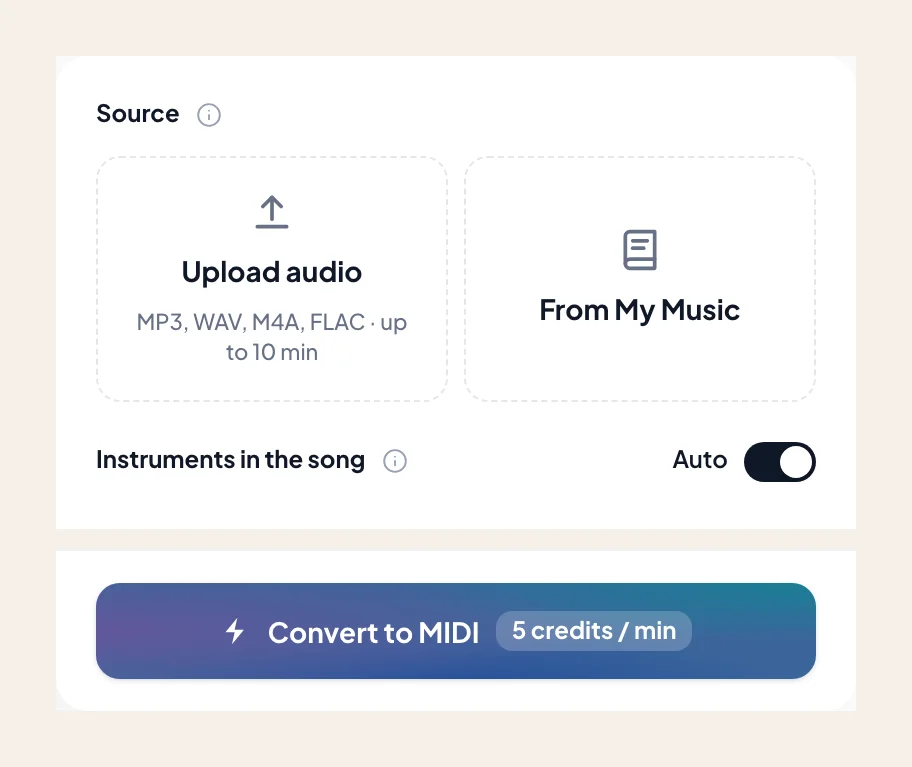
Drop in an MP3, WAV, M4A, or FLAC — a trap 808 bounce, synthwave stem, house bass loop, or full electronic mix. Or pick a track from My Music.
- 2
Keep synth bass preselected in the mask
Synth bass is locked in on this page. Leave it soloed so the engine isolates the electronic low-end oscillator rather than lead synths or drums.
- 3
Verify sub roots and slide notes on the piano roll
Scrub the roll against the low end to verify that 808 octave glides and fast 16th-note filter plucks didn't trigger an octave higher during open-cutoff peaks.
- 4
Download the .mid and trigger your synth rack
Import the .mid into Ableton, FL Studio, or Logic. Enable mono-legato glide on your synth plugin so overlapping slide notes bend smoothly.
Synth bass MIDI ready for monosynths, 808 samplers, and remixing
Once the sub fundamentals and groove lock on the roll, download the .mid for your session. Need bass clef notation for a keyboardist? Visit the Audio to Sheet Music synth bass page.
- 01
Groove-Accurate Synth Bass MIDI (.mid)
History surfaces the unquantized transcription MIDI first — keeping micro-swing, ghosted 16th-note plucks, and legato overlap lengths intact.
- 02
Drop straight onto Serum, Diva, Massive & 808s
Route the .mid into u-he Diva, Xfer Serum, Phase Plant, or an 808 sampler in FL Studio to swap patches, layer clean sine subs, or build a remix.
How to get surgical synth bass MIDI from club and hip-hop mixes
Heavy sidechain compression, distortion saturation, and wide stereo chorus can cloud sub tracking — use these pro workflow tweaks.
Watch out for aggressive resonant filter sweeps
On an acid TB-303 or resonant saw bass, opening the low-pass filter can make an upper harmonic louder than the fundamental. Check sudden one-octave spikes on the roll and pull them back down to the sub octave.
Overlap legato notes to trigger portamento in your VST
When an 808 or Moog slides up an octave, the transcription writes the stepped pitch trajectory. In your DAW, slightly overlap the start and target notes with your synth set to Mono Legato/Always Glide for a seamless pitch bend.
Bridge notes chopped by heavy kick sidechain pumping
If extreme four-on-the-floor sidechain ducking slices a long sustained Reese bass note into quarter-note pulses, simply join the consecutive same-pitch blocks together on your DAW piano roll.
Electronic, hip-hop, and synthwave producers on synth bass MIDI
“Figuring out the exact tuning and high glide notes of a distorted spinz 808 in a reference beat used to be pure guesswork. Seeing the sub fundamentals laid out on the piano roll took five seconds.”
“I needed to recreate a fast 16th-note Oberheim/Moog arpeggio bassline from an 80s italo-disco vinyl rip. The synth bass mask ignored the gated snare and gave me a tight .mid to drop straight onto Diva.”
“Sidechain-pumped UK garage FM basslines have such tricky syncopation. Pulling the unquantized .mid from History preserved the exact shuffle pocket so I could layer a clean sub underneath.”
More electronic synths and bass instruments as MIDI
Switch to sibling bass or synthesizer pages — each opens Audio to MIDI with its own hard mask preselected.
Electric bass
Convert a song or MP3 to electric bass MIDI online. Capture pocket or walking basslines as a .mid — keep electric bass selected, then lock the groove in your DAW.

Acoustic bass
Convert a song or MP3 to upright bass MIDI online. Capture jazz or acoustic bass lines as a .mid — keep acoustic bass selected; this is not the electric bass page.

Piano
Convert a song or MP3 to piano MIDI online. Upload audio up to 10 minutes, keep acoustic piano selected, and download a .mid for Ableton, Logic, or FL Studio — rewrite and revoice in your DAW.
Frequently asked questions
Does Audio to Synth Bass MIDI give accurate results?
How do I use Audio to Synth Bass MIDI?
How does it handle 808 glides and analog portamento slides?
What is the difference between this synth bass page and the electric or acoustic bass pages?
Will a loud kick drum create false bass notes in my MIDI file?
How does heavy sidechain compression affect sustained Reese or sub bass notes?
Can I use the exported .mid to layer a clean sub under a muddy audio bass stem?
Can I try Audio to Synth Bass MIDI for free?
What do I get after conversion?
Can I open the result in my music software?
Can I use the result in my own projects and commercially?
What files can I upload?
How do I get the best result from Audio to Synth Bass MIDI?

Extract your synth bassline into editable MIDI
Upload the track, keep synth bass selected, check the sub roots and glides on the roll, and download the .mid.