Loading…
Audio to Synth Brass MIDI
Turn punchy 80s Oberheim OB-Xa chord stabs, expressive Vangelis-style CS-80 filter swells, and massive cinematic sawtooth brass stacks into editable polyphonic MIDI. Upload MP3, WAV, M4A, or FLAC, keep synth brass preselected, verify the wide two-hand chord voicings on the piano roll, and drop the unquantized .mid onto your polysynth plugins.
Hear the sawtooth filter bite, inspect the synth brass MIDI
Play the source track beside the piano roll. Detuned dual-oscillator sawtooth stacks and snappy brass filter envelopes pack dense harmonic energy — confirm every inner third, seventh, and bass octave in the chord voicing before export.
Reading the MIDI…
Tuned for snappy filter-envelope attacks and wide polysynth chord stacks
Synth-brass hard mask in synthpop and hybrid scores
Preselecting synth brass locks the transcription mask onto the brassy filter-envelope transient and sawtooth/PWM sustain, keeping gated drums, arpeggiator basslines, and lead vocals out of your chord clip.
Polyphonic chord voicings through detuned oscillators
Classic synth brass patches detune two sawtooth oscillators per voice and add pitch-envelope 'blat' on the attack. The model resolves that thick unison chorus into exact, discrete chord notes across five or six voices.
Unquantized .mid for OB-Xa, Prophet, and CS-80 VSTs
History prioritizes the unquantized transcription MIDI so syncopated funk-pop chord punches and laid-back retrowave pads retain their pocket. Load the .mid straight onto Arturia OP-Xa V, CS-80 V, Diva, or Omnisphere.
Analog filter brass — distinct from horns or soft pads
This page targets synthesizer brass patches driven by snappy VCF filter envelopes and saw/pulse waveforms. For real trumpets, trombones, and French horns, use the brass section page; for slow, attackless ambient beds, use synth pad.
How to convert audio to synth brass MIDI
Four steps from an 80s anthem, retrowave stem, or trailer cue to a polyphonic chord .mid.
- 1
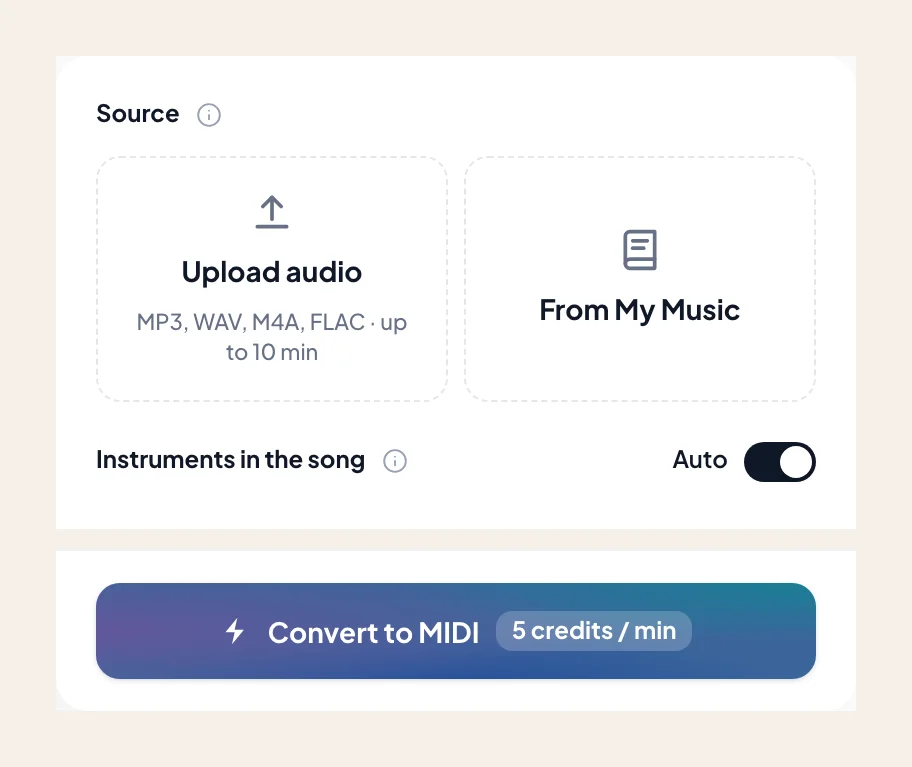
Upload up to 10 minutes of audio
Upload an MP3, WAV, M4A, or FLAC — synthpop chorus stabs, Blade Runner-style CS-80 swells, boogie-funk keyboard hooks, or cinematic hybrid brass stems. Or pick from My Music.
- 2
Keep synth brass preselected in the mask
Synth brass is already active on this landing page. Leave it soloed so the engine isolates the punchy polysynth chords instead of the bass or drums.
- 3
Audit inner chord voicings on the piano roll
Scrub the piano roll alongside the recording to verify that wide 9th/11th chord voicings and syncopated 16th-note stabs didn't pick up sub-oscillator octave doubles.
- 4
Export the .mid to your polysynth rack
Download the unquantized .mid into Ableton, Logic, or Cubase. Pair the notes with aftertouch or CC74 filter cutoff automation to recreate lush analog swells.
Synth brass MIDI built for analog polysynth emulations
When the chord stabs and voicings lock on the roll, download the .mid for your DAW. Need keyboard chord charts or notation? Visit the Audio to Sheet Music synth brass page.
- 01
Polyphonic Synth Brass MIDI (.mid)
History delivers the unquantized transcription MIDI first — capturing exact chord gate lengths, staccato punches, and velocity dynamics.
- 02
Ready for OP-Xa, Prophet-5, CS-80 & Diva
Drop the .mid directly onto your favorite analog polysynth plugin and map velocity to the low-pass filter envelope amount for authentic brass bark.
Getting cleaner synth brass MIDI from unison and fifth-stacked patches
Polysynth programmers often detune oscillators by a fifth or sub-octave — keep your chord voicings accurate with these tips.
Check if Oscillator 2 was tuned +7 semitones (a fifth)
Some 80s synth brass patches tune the second oscillator a perfect fifth above the played key. If a single-finger line shows parallel fifths on the piano roll, you can strip the upper fifth voice before loading a patch that already has OSC 2 tuned to +7.
Ignore pitch-envelope 'blat' on the initial attack
Authentic analog brass uses a fast 30ms pitch-envelope blip on the first oscillator to mimic a horn player's lip buzz. The model locks onto the settled sustain pitch so you don't get spurious grace notes.
Add polyphonic aftertouch or CC1/CC74 for CS-80 swells
A MIDI file records the strike velocity and duration of each chord, while mid-chord filter opening comes from aftertouch or mod wheel. Draw a quick cutoff curve in your DAW to make long held chords bloom.
Retrowave, synthpop, and score producers on synth brass MIDI
“Picking apart six-voice Oberheim OB-Xa jazz-funk chord stabs from a dense 1984 mix used to drive me crazy because of the stereo chorus. The piano roll nailed every inner voicing.”
“We wanted to double a vintage Prophet-5 brass hook from an archival multitrack with modern cinematic horns. Having the unquantized .mid preserved the slightly pushed upbeat timing.”
“The hard mask separated our CS-80 brass swells from the sub-bass drone and arpeggiators underneath. Dropping that .mid onto Arturia CS-80 V with poly-aftertouch sounded massive.”
More synthesizers, keyboards, and brass instruments as MIDI
Explore sibling pages for synth pad, synth lead, or acoustic brass — each preselects its own mask.

Trumpet
Convert a song or MP3 to trumpet MIDI online. Capture the lead brass line as a .mid — keep trumpet selected, then rewrite in your DAW.
Trombone
Convert a song or MP3 to trombone MIDI online. Capture the trombone line as a .mid — keep trombone selected, then rewrite in your DAW.
French horn
Convert a song or MP3 to French horn MIDI online. Capture the horn call / line as a .mid — keep French horn selected, then rewrite in your DAW.
Frequently asked questions
Does Audio to Synth Brass MIDI give accurate results?
How do I use Audio to Synth Brass MIDI?
How is the synth brass MIDI page different from the brass section or synth pad pages?
Can it transcribe dense 5- or 6-note polysynth chord stabs accurately?
Does the exported MIDI include filter cutoff sweeps or pitch-bend wheel movements?
What if the synth brass patch has a sub-oscillator engaged?
Will gated snare drums bleed into my 80s synth brass stabs?
Can I try Audio to Synth Brass MIDI for free?
What do I get after conversion?
Can I open the result in my music software?
Can I use the result in my own projects and commercially?
What files can I upload?
How do I get the best result from Audio to Synth Brass MIDI?
Convert your synth brass chords into editable MIDI
Upload the track, keep synth brass selected, check the chord voicings on the roll, and download the .mid.