Loading…

Song to Tubular Bells MIDI
Decode solemn orchestral tubular bells (symphonic chimes), dramatic trailer tolling, and liturgical tower-chime motifs into accurate, editable MIDI. Because cylindrical brass tubes produce fierce inharmonic overtones that trick human ears on the fundamental pitch, our pitch engine resolves the true struck tube — upload MP3, WAV, M4A, or FLAC, keep tubular bells preselected, verify the tolling notes on the piano roll, and download the .mid.
Hear the rawhide hammer strike, verify the true chime fundamental
Play the chime recording beside the piano roll. When a rawhide hammer strikes the brass tube's crown, modes 4, 5, and 6 create a virtual pitch while lower modes ring at strange intervals — confirm the exact concert chime note visually before export.
Reading the MIDI…
Engineered to decode the acoustic paradox of cylindrical brass chimes
Resolves inharmonic 4:5:6 modes to the true struck pitch
A suspended metal tube has no real acoustic fundamental at its perceived pitch; instead, its 4th, 5th, and 6th transverse vibration modes sit in a near-2:3:4 ratio that fools the brain (and naive pitch trackers) into hearing wrong octaves or fourths. Our model maps that complex modal cluster back to the exact chromatic tube struck (C4–F5).
Tubular-bells hard mask in full orchestral tuttis
Orchestral chimes usually toll right through the climax of a brass-and-choir tutti or heavy trailer percussion hit. Preselecting tubular bells applies a hard mask that zeroes in on the metallic crown-strike signature while ignoring timpani booms and trombones.
Damper-bar sustain tails and solemn tolling pacing
Unless muted by the chime frame's foot damper bar, brass tubes ring for 10+ seconds with beating partials. History provides the unquantized .mid first so dramatic rubato tolling and damper-bar cutoffs transfer directly into your scoring template.
Hanging brass tubes — distinct from glockenspiel or timpani
Tubular bells sit in the C4–G5 compass with deep, solemn church-bell overtones struck by a rawhide mallet. Use the glockenspiel page for tiny C5–C8 steel bars, or the orchestral drums page for low-end timpani and gran cassa.
How to convert a song to tubular bells MIDI
Four steps from a symphonic finale, liturgical recording, or trailer stem to an accurate chime .mid.
- 1
Upload up to 10 minutes of chime audio
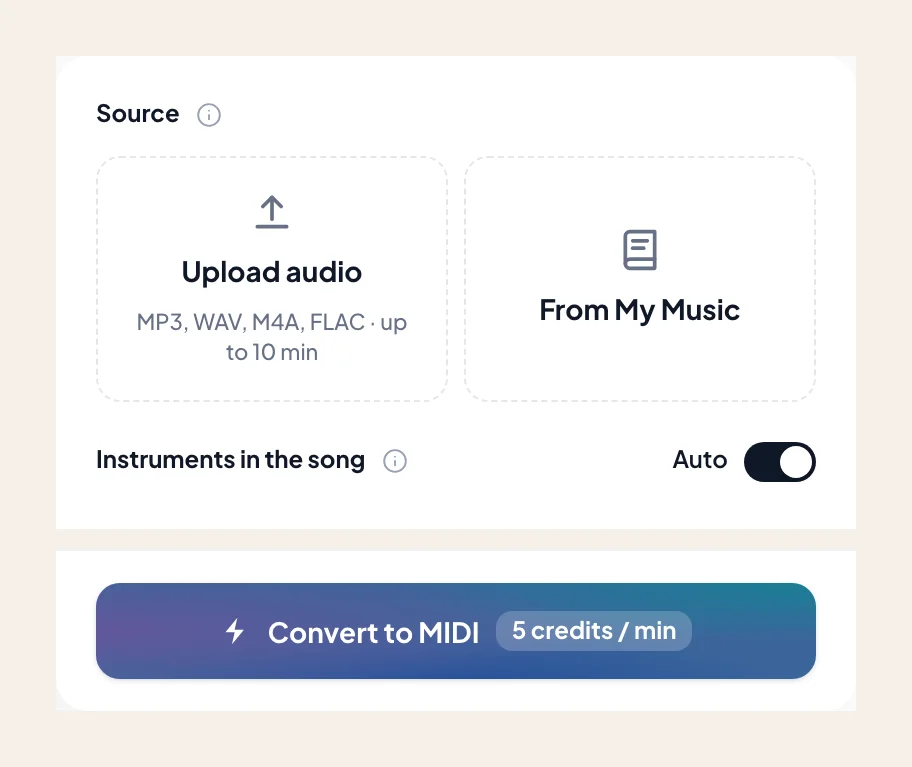
Drop in an MP3, WAV, M4A, or FLAC — Berlioz/Puccini orchestral chime passages, dark fantasy trailer tolls, holiday carillon hooks, or prog-rock tubular bell tracks. Or select from My Music.
- 2
Keep tubular bells preselected in the mask
Tubular bells is locked in on arrival. Leave it soloed so the engine isolates the cylindrical brass chime modes rather than surrounding brass or choir.
- 3
Verify the resolved fundamental pitch on the piano roll
Scrub the piano roll alongside the audio to confirm that every chime strike sits inside the concert C4–G5 compass without spurious fifth or minor-sixth modal shadows.
- 4
Download the .mid into your orchestral DAW template
Import the unquantized .mid into Cubase, Logic, or Pro Tools and trigger VSL, Spitfire, or Orchestral Tools Tubular Bells with rawhide or soft-face hammer patches.
Tubular bells MIDI ready for symphonic chime libraries and trailers
Once the chime fundamentals and damper tails check out on the roll, download the .mid for your session. Need treble-clef chime notation? Visit the Audio to Sheet Music tubular bells page.
- 01
Fundamental-Resolved Chime MIDI (.mid)
History surfaces the unquantized transcription MIDI first — delivering clean C4–G5 fundamental trigger notes rather than a mess of inharmonic overtone partials.
- 02
Ready for VSL, Spitfire & Cinematic Chime VSTs
Drop the .mid straight onto orchestral tubular bells or church-bell patches in Kontakt, Sine, or Opus and control damper-bar releases in your DAW.
Avoiding overtone traps when transcribing tubular bells
Even seasoned conductors argue over which octave a chime is actually sounding — use these acoustic insights in your DAW.
Trust the C4–G5 concert compass over phantom sub-octaves
Because a chime's clang tone and lower vibration modes create a psychoacoustic 'hum note' below the perceived pitch, human ears often guess a chime is an octave lower than the written C4–F5 rack. Check the piano roll against your VST's playable C4–G5 range.
Delete any secondary modal ringing after a hard rawhide hit
An aggressive fortissimo blow to the tube crown can briefly excite an upper mode a fourth or sixth above the perceived fundamental. If a faint secondary note appears right above a tolling strike on the roll, mute it before export.
Trim damper-bar releases before layering wet samples
If the source recording has undecayed 8-second chime tails overlapping each other, shorten the MIDI note ends slightly or add a CC64 pedal cutoff so your sample library doesn't build up muddy metallic dissonance.
Orchestral composers and trailer producers on tubular bells MIDI
“Transcribing chimes by ear is a famous orchestrator's nightmare because the inharmonic partials make you second-guess whether the player struck C5, G4, or F4. This tool resolved the exact fundamental tube on our reference score immediately.”
“In dark fantasy trailer cues, we layer tubular bells with brass blasts and choir. Preselecting tubular bells stripped out the trombones and gave us the exact solemn tolling intervals to trigger our Spitfire chimes.”
“Standard audio-to-MIDI plugins spit out five random discordant notes for every single chime strike because of the tube overtones. Seeing one clean MIDI block per hammer hit on this piano roll was incredible.”
More orchestral chimes, mallets, and liturgical instruments as MIDI
Explore sibling pages for glockenspiel, church organ, celesta, or marimba — each preselects its own hard mask.

Drums
Convert a song or MP3 to drum MIDI online. Capture kit grooves and fills as drum MIDI for a drum rack — keep drums selected, then remap hits in your drum rack.

Timpani
Convert a song or MP3 to timpani MIDI online. Capture pitched timp hits as a .mid — keep timpani selected; this is not kit drum MIDI.

Vibraphone
Convert a song to vibraphone MIDI online. Transcribe 4-mallet jazz comping, damper-pedal sustain chords, and motor-vibrato bell lines into a DAW .mid.
Frequently asked questions
Does Song to Tubular Bells MIDI give accurate results?
How do I use Song to Tubular Bells MIDI?
Does tubular bells MIDI capture the perceived fundamental strike pitch or the raw overtones?
Why do my ears hear a lower octave 'hum' when listening to tubular bells?
How is this page different from the glockenspiel or orchestral drums pages?
How does the MIDI handle the chime frame's foot damper bar?
Can I get printable tubular bells sheet music for a percussionist?
Can I try Song to Tubular Bells MIDI for free?
What do I get after conversion?
Can I open the result in my music software?
Can I use the result in my own projects and commercially?
What files can I upload?
How do I get the best result from Song to Tubular Bells MIDI?

Convert your tubular bells audio into accurate MIDI
Upload the recording, keep tubular bells selected, verify the resolved chime fundamentals on the roll, and download the .mid.