Loading…

Song to Xylophone MIDI
Turn brisk rosewood or Kelon xylophone runs, brittle orchestral double-stops, and virtuosic ragtime mallet solos into razor-sharp MIDI. Upload MP3, WAV, M4A, or FLAC, keep xylophone preselected, inspect the dry staccato strike pitches on the piano roll, and load the unquantized .mid straight into your DAW.
Hear the snappy wooden transient, verify the xylophone MIDI
Play the audio beside the piano roll. Because xylophone bars are struck with hard rubber or polyball mallets and have almost zero sustain, every 32nd-note run and rapid single-stroke roll stands out as crisp, discrete blocks.
Reading the MIDI…
Engineered for dry rosewood attacks, ultra-short decay, and twelth-tuned harmonics
Xylophone-only hard mask that rejects snare and woodblock
A hard poly-mallet strike on a high rosewood bar has a sharp percussive snap that generic tools confuse with rimshots or woodblocks. Preselecting xylophone locks the hard mask onto pitched wooden bar fundamentals.
Twelfth-tuned overtones resolved to the true fundamental
Unlike marimbas (whose bars are arch-cut to tune the second overtone two octaves up), concert xylophone bars are undercut to emphasize the third harmonic — a twelfth (octave plus a fifth) above the pitch. Our model locks onto the true struck bar rather than the fifth overtone.
Crisp 32nd-note runs and single-stroke tremolos
Because dry wooden bars decay within milliseconds, xylophonists sustain notes via rapid alternating single-stroke mallet rolls. History delivers the unquantized .mid first so every individual mallet articulation and ragtime grace note stays intact.
Brittle upper-register wood — distinct from marimba
Xylophone sits an octave higher with thick, narrow bars and short resonators for a biting, dry projection that cuts through an orchestra. For warm, resonant four-mallet wooden chords extending down into the bass register, use the marimba page.
How to convert a song to xylophone MIDI
Four steps from a symphonic excerpt, animation cue, or chamber recording to an editable mallet .mid.
- 1
Upload up to 10 minutes of xylophone audio
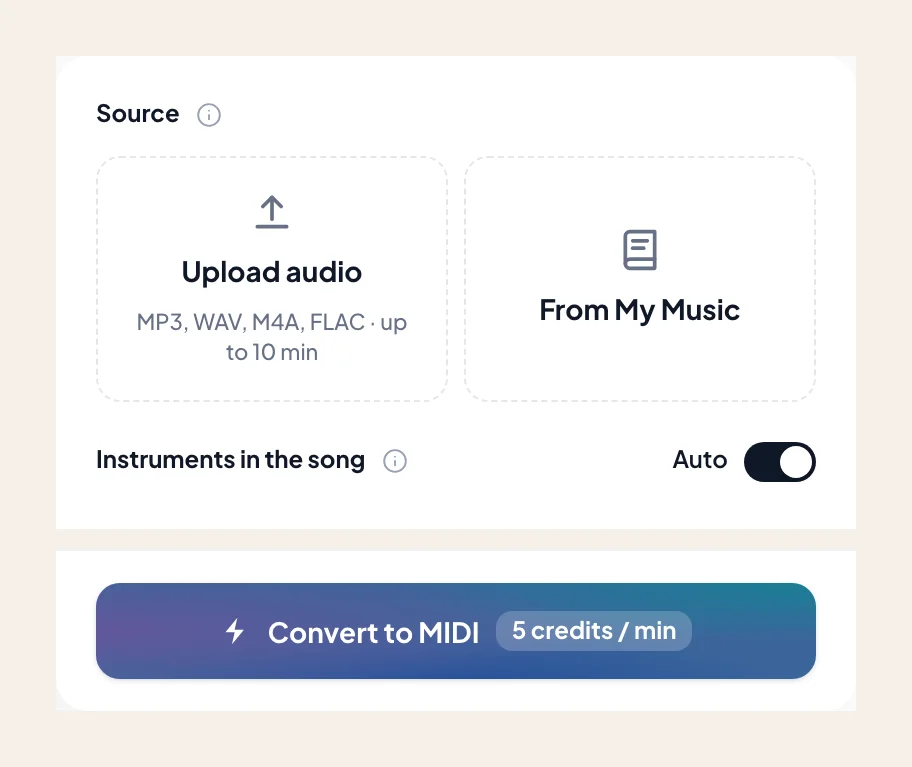
Drop in an MP3, WAV, M4A, or FLAC — Shostakovich/Stravinsky orchestral excerpts, vintage novelty ragtime solos, cartoon scoring cues, or contemporary percussion ensemble tracks. Or pick from My Music.
- 2
Keep xylophone locked in the instrument mask
Xylophone is already selected when you start here. Leave it soloed so the engine tracks the pitched wooden mallet strikes instead of pizzicato strings or snare drum.
- 3
Check fast scalar runs and rolls on the piano roll
Scrub the roll against the recording to confirm that rapid chromatic scales, double-stops, and single-stroke rolls didn't pick up twelfth-harmonic shadows.
- 4
Export the .mid into your orchestral percussion rack
Download the unquantized .mid into Cubase, Logic, or Dorico. Route it to a rosewood xylophone library and select hard rubber or rosewood mallets.
Xylophone MIDI built for orchestral mock-ups and percussionists
When the snappy bar attacks line up on the roll, download the .mid for your DAW. Need treble-clef xylophone sheet music? Visit the Audio to Sheet Music xylophone sibling page.
- 01
Transient-Accurate Xylophone MIDI (.mid)
History prioritizes the unquantized transcription MIDI — preserving blisteringly fast mallet passages, grace-note flams, and exact short gate durations.
- 02
Ready for VSL, Spitfire & Mallet Flux libraries
Drop the .mid onto any concert or vintage novelty xylophone patch in Kontakt, Sine, or Opus and adjust mallet velocity curves without manual step-entry.
Tips for clean xylophone MIDI from fast orchestral and chamber takes
Twelfth-harmonic tuning and doubled piccolo/pizzicato lines are classic orchestral traps — keep your piano roll clean with these tips.
Watch for the signature twelfth (octave + fifth) overtone
Because Western concert xylophones tune their primary overtone to a twelfth above the fundamental (giving the instrument its dry, hollow 'clack'), an aggressive hard-mallet strike can occasionally excite that fifth. Check high outlier notes on the roll before export.
Check sounding pitch vs. 8va written transposition
Xylophone sounds one octave higher than written on orchestral scores. Our MIDI exports true sounding concert pitch (C5–C8); transpose down 12 semitones in your DAW if your sample library maps keys to written pitch (C4–C7).
Decide between real mallet rolls and keyswitch roll patches
The transcription writes every physical mallet hit inside a sustained tremolo roll. If you prefer to trigger your VST's pre-recorded 'Roll' keyswitch patch, simply replace the rapid repeated blocks with a single held note in your DAW.
Percussionists and media composers on xylophone MIDI
“Transcribing a 1920s George Hamilton Green ragtime xylophone solo by ear is almost impossible at 160 BPM. Being able to scrub the piano roll and see every double-stop and grace-note flam saved me days of slow-down work.”
“In our animation score, the xylophone was constantly doubling fast woodwind runs. The hard mask locked right onto the dry rosewood clack and ignored the clarinets so we could re-layer a brighter Kelon patch.”
“Standard pitch trackers always get fooled by the xylophone's twelfth overtone and write wrong fifths above the melody. This model nailed the actual struck fundamentals across the whole 3.5-octave range.”
More mallet percussion and orchestral instruments as MIDI
Switch to sibling pages for marimba, glockenspiel, or vibraphone — each preselects its own hard mask.

Drums
Convert a song or MP3 to drum MIDI online. Capture kit grooves and fills as drum MIDI for a drum rack — keep drums selected, then remap hits in your drum rack.

Timpani
Convert a song or MP3 to timpani MIDI online. Capture pitched timp hits as a .mid — keep timpani selected; this is not kit drum MIDI.

Vibraphone
Convert a song to vibraphone MIDI online. Transcribe 4-mallet jazz comping, damper-pedal sustain chords, and motor-vibrato bell lines into a DAW .mid.
Frequently asked questions
Does Song to Xylophone MIDI give accurate results?
How do I use Song to Xylophone MIDI?
How is the xylophone MIDI page different from the marimba MIDI page?
Does the exported xylophone MIDI use sounding pitch or written transposing pitch?
How are sustained xylophone tremolos (mallet rolls) represented in the MIDI?
Will woodblocks, rimshots, or temple blocks bleed into the xylophone MIDI?
Can I get printable xylophone sheet music with sticking cues instead?
Can I try Song to Xylophone MIDI for free?
What do I get after conversion?
Can I open the result in my music software?
Can I use the result in my own projects and commercially?
What files can I upload?
How do I get the best result from Song to Xylophone MIDI?

Convert your xylophone recording into editable MIDI
Upload the audio, keep xylophone selected, check the fast mallet runs on the roll, and download the .mid.