Loading…

Song to Bagpipe MIDI
Extract intricate bagpipe chanter melodies and lightning-fast grace-note cuttings into editable MIDI. Upload an MP3, WAV, M4A, or FLAC, keep bagpipe selected to isolate the reed pipe voice from marching drums or folk guitars, inspect doublings and birls on the piano roll, and drop the .mid into your DAW.
Hear the pipes, see the chanter melody and drones on the roll
Play your recording beside the piano roll. With constant airflow and no silence between notes, seeing how high-G grace notes, grips, and bass/tenor drones separate on the roll lets you trust the transcription before export.
Reading the MIDI…
Bagpipe MIDI built for continuous-airflow chanter lines and drones
Bagpipe-only hard mask against pipe-band drums and folk ensembles
Launching Audio to MIDI from this page locks in the bagpipe hard mask. Crisp Scottish side-drum rolls, bass drum thuds, and Celtic rhythm guitars are excluded so only the pipe reeds enter your MIDI clip.
Separates the active 9-note chanter melody from steady bass & tenor drones
Because a bagpipe never stops sounding, pipers articulate repeated pitches using millisecond grace-note 'cuttings' (doublings, strikes, grips, and birls) over sustained Bb/A drones. The piano roll clearly distinguishes the upper chanter scale from the low drone pedals below.
Unquantized .mid ready for Celtic & orchestral pipe libraries
History gives you the unquantized transcription MIDI first so those 30-millisecond ornamental grace flicks aren't crushed onto a 16th-note grid. Load the .mid into Universal Piper, Soundiron, or CineWinds in Logic, Cubase, or Reaper.
Distinct from shanai folk horns and orchestral oboes
Unlike a mouth-blown oboe or Indian shanai that uses breath pauses and wide pitch glides, bagpipes use a fixed mixolydian chanter scale backed by constant drone pipes. Use the Shanai or Oboe pages when transcribing non-drone double reeds.
How to convert a song into bagpipe MIDI
Four steps from a Highland solo or Celtic rock track to an editable .mid file.
- 1
Upload up to 10 minutes of bagpipe audio
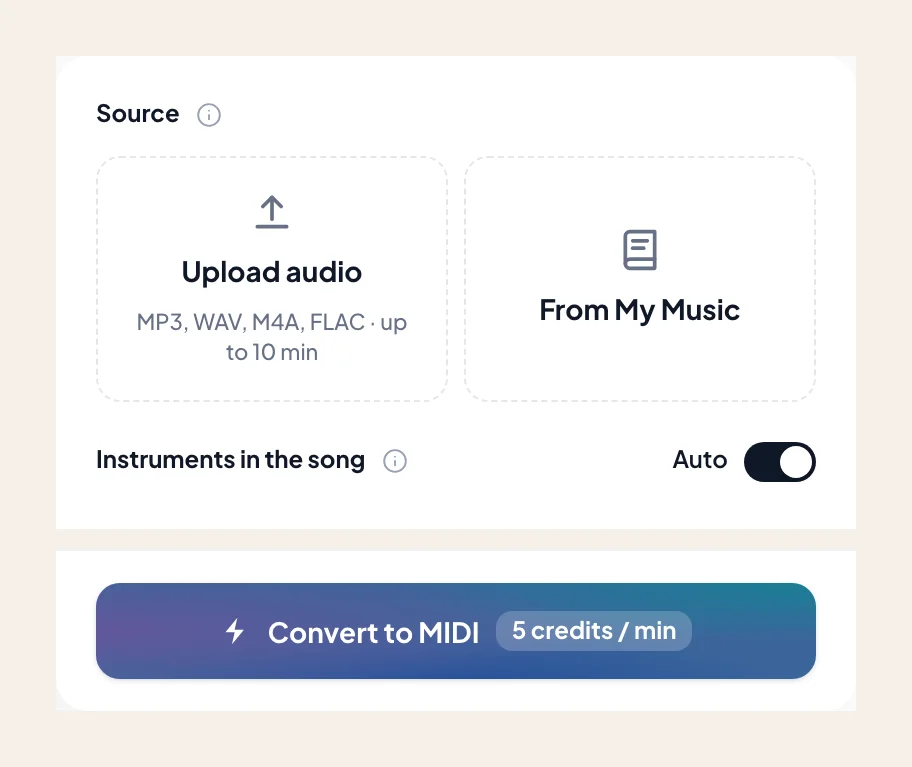
Select an MP3, WAV, M4A, or FLAC — a solo pibroch, a marching reel or strathspey, or a cinematic folk cue. Or choose a track from My Music.
- 2
Keep bagpipe selected
Bagpipe is preselected here. Leave it isolated so marching snare cadences or orchestral brass don't mix into your chanter transcription.
- 3
Inspect chanter cuttings and low drone bars on the piano roll
Scrub the roll against the audio to check the melody in the upper octave and decide whether to keep or mute the sustained bass and tenor drone notes below.
- 4
Download .mid and route to your pipe or orchestral patch
Import the .mid into your DAW, delete or split the low drone notes if your virtual bagpipe patch generates its own internal drones, and fine-tune the grace ornaments.
Bagpipe MIDI ready for film scoring and folk production
Export the .mid straight into your DAW session. If you need printable chanter staff notation with grace-note stems, visit the Audio to Sheet Music bagpipe page.
- 01
Unquantized Transcription MIDI (.mid)
Captures both the chanter melody and the ultra-short ornamental cuttings that separate identical consecutive melody notes.
- 02
Easy Drone-Split Workflow in Any DAW
Open the .mid in Logic, Cubase, Ableton, or FL Studio, marquee-select the bottom drone octave in one drag, and feed the clean top melody to any Celtic virtual instrument.
Practical tips for cleaner bagpipe chanter MIDI
Great Highland Bagpipes pitch around A≈475–480 Hz and sound continuous drones — here is how to handle both.
Account for Highland pipe pitch (~A476–480 Hz)
Traditional Highland chanters play sharper than standard A440 Bb (often sounding close to B natural in A440). Check the transcribed key on the piano roll and transpose by -1 semitone in your DAW if you need standard Bb concert alignment.
Strip the bottom drone notes when using dedicated pipe plugins
Most virtual bagpipe libraries have a dedicated drone toggle switch. In your DAW piano roll, simply delete the long sustained bass/tenor notes below the chanter register so the plugin doesn't double-trigger drones.
Never hard-quantize bagpipe grace notes to 1/16th grids
A piper's high-G grace note or birl lasts only a fraction of a thirty-second note. Keep the unquantized transcription timing intact so your chanter articulations still snap.
Celtic arrangers and film composers using bagpipe MIDI
“Highland pipes play at A480 and never stop breathing, which breaks almost every audio-to-MIDI tool I've tried. Seeing the high-G doublings cleanly separated above the drone line on the roll was a revelation.”
“I had to orchestrate low brass and strings underneath a live pipe band recording. Exporting the chanter MIDI let me verify the exact strathspey rhythm and pitch center in Cubase immediately.”
“Deleted the two sustained drone notes at the bottom of the .mid clip in two seconds, routed the upper chanter melody to our sample library, and all the birls and grips stayed right in the pocket.”
More double reeds and folk wind instruments as MIDI
Explore sibling folk winds and double reeds — each page opens Audio to MIDI with that voice preselected.

Flute
Convert a song or MP3 to flute MIDI online. Capture an exposed flute line as a .mid — keep flute selected, then rewrite phrasing in your DAW.
Clarinet
Convert a song or MP3 to clarinet MIDI online. Capture a clarinet solo line as a .mid — keep clarinet selected, then rewrite in your DAW.
Soprano & alto sax
Convert a song or MP3 to alto or soprano sax MIDI online. Capture the sax melody as a .mid — keep alto / soprano sax selected, then rewrite in your DAW.
Frequently asked questions
Does Song to Bagpipe MIDI give accurate results?
How do I use Song to Bagpipe MIDI?
Does bagpipe MIDI transcribe only the chanter melody or the constant drones too?
How does the converter handle Highland bagpipes tuned to A476–A480 Hz?
Do rapid grace notes like doublings, grips, and birls show up in the MIDI?
How is this page different from the Shanai or Oboe MIDI pages?
Can I get printable bagpipe sheet music instead of a DAW MIDI file?
Can I try Song to Bagpipe MIDI for free?
What do I get after conversion?
Can I open the result in my music software?
Can I use the result in my own projects and commercially?
What files can I upload?
How do I get the best result from Song to Bagpipe MIDI?

Convert your bagpipe recording to editable MIDI
Upload your pipe track, keep bagpipe selected, and download a .mid with clean chanter lines for your DAW.