Loading…

Song to Whistle MIDI
Turn lively Celtic tin whistle tunes, low whistle airs, and catchy whistled hooks into editable MIDI. Upload an MP3, WAV, M4A, or FLAC, keep whistle selected so bodhrán drums, fiddles, and acoustic guitars stay masked out, inspect cuts and rolls on the piano roll, and bring the .mid into your DAW.
Hear the pennywhistle lilt, inspect every cut and tap on the roll
Play your recording beside the piano roll. Fast 6/8 jig triplets, upper-finger cuts, lower-finger taps, and second-octave overblown leaps are easy to check against the audio before you export.
Reading the MIDI…
Whistle MIDI built for Irish ornamentation and bright fipple leads
Whistle-only hard mask away from fiddle, bodhrán, and pub-session backing
Opening Audio to MIDI here locks the hard mask onto the whistle line. Driving bodhrán frame drums, acoustic DADGAD guitar strums, and accordion chords are filtered out so your MIDI clip stays focused on the high whistle melody.
Resolves rapid Celtic cuts, taps, cranns, and long/short rolls
Tin whistle players rarely use their tongue to separate notes—instead they articulate repeated pitches with millisecond finger 'cuts' (lifting a finger above) and 'taps' (striking a finger below). The unquantized piano roll captures both the main melody and these flicked ornamental dividers.
Unquantized .mid ready for Celtic wind libraries & indie pop hooks
History gives you the unquantized transcription MIDI first so the natural swing of a double jig or slip jig isn't flattened. Drop the .mid onto a pennywhistle, low whistle, or synth lead patch in Logic, Ableton, Cubase, or FL Studio.
Distinct from orchestral piccolo and Baroque recorder
Unlike a keyed orchestral piccolo playing equal-tempered chromatic marches or a wooden Baroque recorder using tongued divisions, the whistle page is tuned for 6-hole diatonic fipple pipes (High D, Low D) and breathy human-whistled topline hooks.
How to convert a song into whistle MIDI
Four steps from a Celtic session tune or whistled vocal hook to an editable .mid file.
- 1
Upload up to 10 minutes of whistle audio
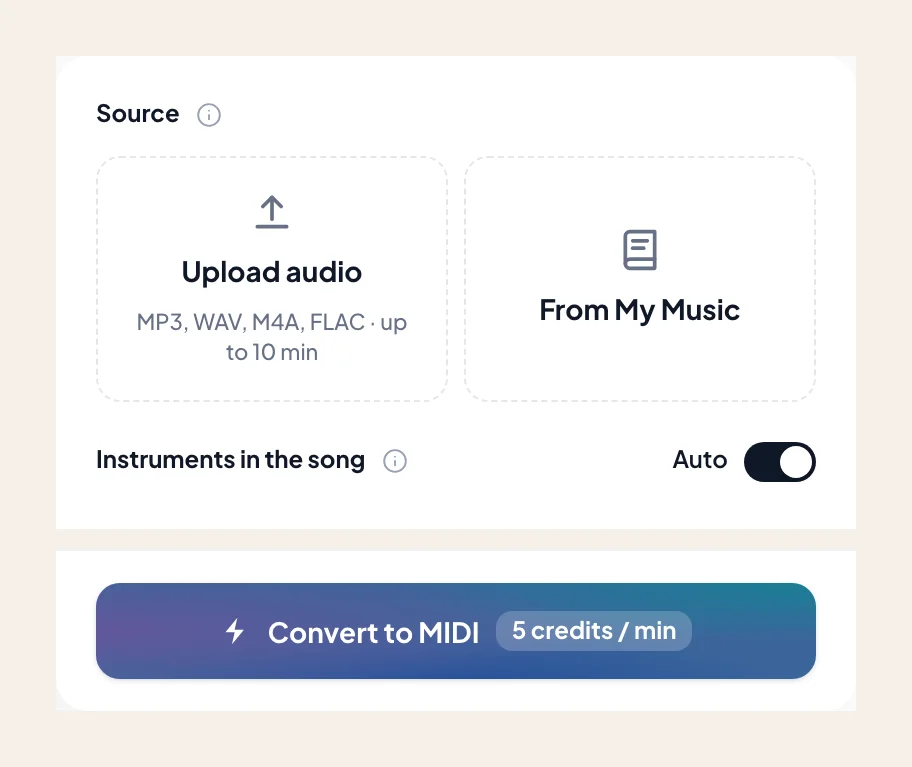
Drop an MP3, WAV, M4A, or FLAC — a fast High-D pennywhistle reel, a haunting Low-D whistle film air, or an indie-pop whistled chorus hook. Or pick a track from My Music.
- 2
Keep whistle selected
Whistle is preselected on this landing. Leave it isolated unless you want an unison fiddle or flute line transcribed into the same MIDI clip.
- 3
Check second-octave leaps and finger rolls on the piano roll
Scrub the roll against the recording to verify that breath-overblown second-octave jumps (D6–B6) and three-part Irish rolls landed cleanly.
- 4
Download .mid and shape ornaments in your DAW
Import the .mid into your DAW to trigger Celtic virtual instruments, harmonize the melody with strings, or clean up grace flicks.
Whistle MIDI exports for folk arrangers and pop producers
Take the .mid straight into your DAW when the roll looks right. If you need printable staff notation for a session tune book, visit the Audio to Sheet Music whistle page.
- 01
Unquantized Transcription MIDI (.mid)
Retains the authentic lilt of 6/8 jigs, 4/4 reels, slow airs, and breath-glided slides without snapping grace cuts onto a robotic grid.
- 02
Ready for CineWinds, Eduardo Tarilonte Celtic Winds & Synths
Load directly into Logic, Cubase, Ableton, or FL Studio to drive sampled tin whistles, low whistles, or doubled pop lead synths.
Get cleaner whistle MIDI from session tunes and pop mixes
In traditional Irish music, fiddle, flute, and whistle often play the exact same melody in unison or octaves.
Isolate the whistle when playing unison with a fiddle
Traditional session recordings often layer tin whistle and fiddle on the same reel melody. Run Stem Splitter first if bowed string harmonics make the whistle attacks harder to separate.
Decide whether to keep fingered rolls or use library keyswitches
A live five-note Irish roll transcribes as the main note split by ultra-short upper cut and lower tap blips. If your Kontakt whistle library has a built-in 'Roll' keyswitch, simply merge those three notes on the DAW roll and trigger the keyswitch.
Works for both metal/wooden fipple whistles and human whistling
Because human lip-whistling and a high fipple pennywhistle share a focused, narrow-band fundamental in the D5–D7 range, this page cleanly transcribes both Celtic tin whistles and whistled pop hooks.
Celtic arrangers and indie producers turning whistle audio into MIDI
“I learn hundreds of Irish reels by ear, and sometimes a player flies through a cran or a short roll so fast you can't tell which grace finger moved. Seeing the exact cut-and-tap notes on the piano roll is magic.”
“We whistled a topline hook into a condenser mic for an indie commercial and used this page to turn the human whistle into MIDI so our synth brass and marimba could double it note for note.”
“Low D whistle solos in film cues have so much airy chiff on the bottom notes that standard converters drop them an octave. The whistle mask kept the entire slow air in the right register.”
More folk flutes and woodwind instruments as MIDI
Explore sibling flutes, pipes, and reeds — each page opens Audio to MIDI with that voice preselected.

Flute
Convert a song or MP3 to flute MIDI online. Capture an exposed flute line as a .mid — keep flute selected, then rewrite phrasing in your DAW.
Clarinet
Convert a song or MP3 to clarinet MIDI online. Capture a clarinet solo line as a .mid — keep clarinet selected, then rewrite in your DAW.
Soprano & alto sax
Convert a song or MP3 to alto or soprano sax MIDI online. Capture the sax melody as a .mid — keep alto / soprano sax selected, then rewrite in your DAW.
Frequently asked questions
Does Song to Whistle MIDI give accurate results?
How do I use Song to Whistle MIDI?
Does this page work for High D tin whistles, Low D whistles, and human whistling?
How do Irish ornaments like cuts, taps, rolls, and slides show up in the MIDI?
Why use the Whistle page instead of the Piccolo or Flute MIDI pages?
What if an acoustic guitar or bodhrán drum is playing behind the whistle?
Where can I get printable tin whistle sheet music?
Can I try Song to Whistle MIDI for free?
What do I get after conversion?
Can I open the result in my music software?
Can I use the result in my own projects and commercially?
What files can I upload?
How do I get the best result from Song to Whistle MIDI?
Convert your whistle melody to editable MIDI
Upload your tin whistle tune or whistled hook, keep whistle selected, and download a .mid for your DAW.