Loading…

Song to Shakuhachi MIDI
Translate evocative shakuhachi bamboo flute recordings into editable MIDI. Upload an MP3, WAV, M4A, or FLAC, leave shakuhachi selected so koto plucks, taiko drums, and synth pads stay masked out, inspect head-tilt pitch bends on the piano roll, and load the .mid into your DAW.
Hear the bamboo breath, inspect the shakuhachi pitch contour on the roll
Play the recording beside the piano roll. Explosive mura-iki breath attacks, subtle meri downward head dips, and pentatonic finger flicks (atari) are easy to verify against the source audio before export.
Reading the MIDI…
Shakuhachi MIDI that locks onto pitch through heavy air and breath noise
Shakuhachi-only hard mask away from koto, shamisen, and strings
Opening Audio to MIDI here preselects shakuhachi as a strict hard mask. Plucked koto arpeggios, ambient synth drones, and cinematic taiko hits are ignored so only the bamboo wind line writes to your MIDI clip.
Tracks core pitch through utaguchi wind noise and meri/kari head tilts
Blowing across a notched bamboo edge (utaguchi) mixes up to 40% rushing air with the fundamental tone, while tilting the chin down (meri) or up (kari) shifts pitch by a semitone or full tone. The model cuts through the white-noise breath cloud to trace the true melodic core.
Unquantized .mid built for free-tempo Honkyoku & anime scoring
History surfaces the unquantized transcription MIDI first—essential for shakuhachi solos that breathe without a metronome. Drop it into Premier Sound Factory, Impact Soundworks Ventus, or Omnisphere in Logic, Cubase, or Ableton.
Distinct from Western concert flute and fipple recorder
Unlike a silver concert flute with even tempered keywork or a recorder with a fixed fipple windway, a 5-hole shakuhachi relies on half-holing and deep embouchure angle shifts. Use the Flute or Recorder pages for Western woodwinds.
How to convert a song into shakuhachi MIDI
Four steps from a meditative bamboo solo or film cue to an editable .mid file.
- 1
Upload up to 10 minutes of shakuhachi audio
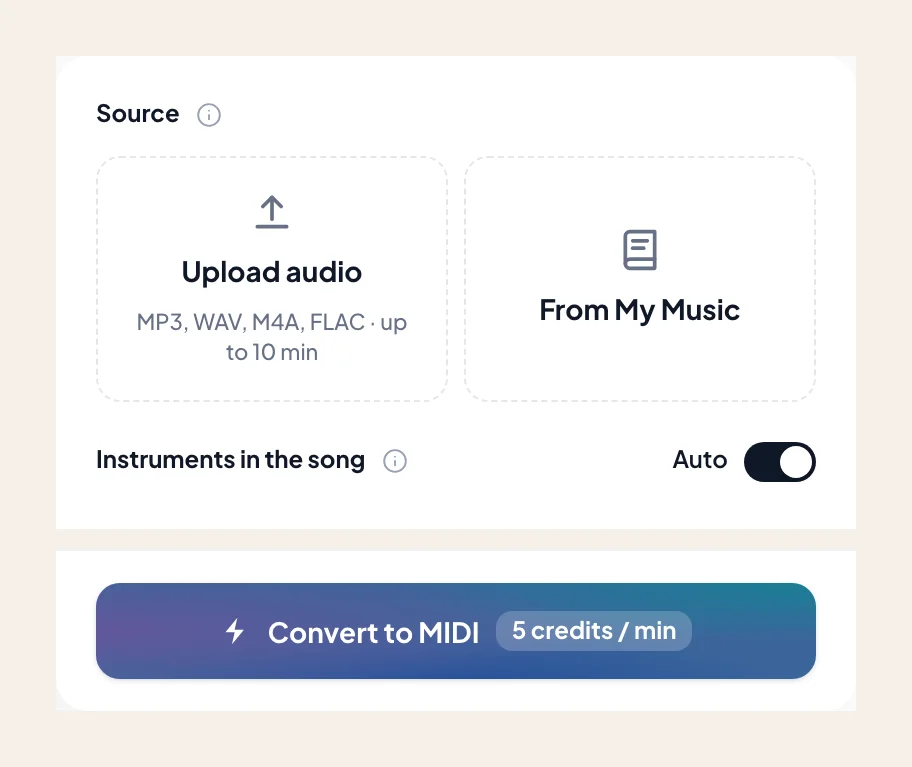
Drop an MP3, WAV, M4A, or FLAC — a traditional Zen Honkyoku solo, an anime battle theme, or a 1980s synth-pop bamboo flute hook. Or pick a track from My Music.
- 2
Keep shakuhachi selected
Shakuhachi is preselected on this landing. Keep it solo unless you want accompanying koto or shamisen parts merged into the same MIDI file.
- 3
Review breath attacks and meri pitch dips on the piano roll
Scrub the roll beside the audio to check where explosive air attacks settle onto the core pitch and how deep chin-tilt bends step down and back up.
- 4
Download .mid and add breath expression in your DAW
Import the .mid into Logic, Cubase, Ableton, or FL Studio, pair it with a virtual shakuhachi library, and draw CC11/CC2 breath curves and pitch bends.
Shakuhachi MIDI ready for film, game, and ambient producers
Download the unquantized .mid straight into your session. Need printable Western staff notation instead of Kinko/Tozan katakana tablature? Visit the Audio to Sheet Music shakuhachi page.
- 01
Unquantized Transcription MIDI (.mid)
Preserves organic rubato phrasing, lingering phrase decays, and sudden finger-slap articulations (atari) without grid distortion.
- 02
Ready for Ventus, Kontakt World Winds & Omnisphere
Drop onto dedicated Japanese bamboo flute sample libraries or iconic vintage sampler patches in any DAW that reads Standard MIDI.
Cleaner shakuhachi MIDI from breath-heavy bamboo recordings
Because players intentionally use explosive air blasts (mura-iki) and head-nod vibrato (yuri), a quick review on the roll pays off.
Check mura-iki breath blasts for octave harmonic jumps
When a player blasts hard across the blowing edge, the second harmonic briefly spikes an octave higher (kan register). Scrub the attack on the piano roll to make sure a ro-register note didn't split into an extra octave-up blip.
Merge meri/kari semitone steps into smooth Pitch Bend lanes
A classic half-step chin dip (chū-meri) transcribes as a step down and back up on the piano roll. In your DAW, join the notes and automate your virtual instrument's pitch wheel or meri keyswitch for seamless bamboo portamento.
Use Stem Splitter when taiko cymbals or synth pads mask the air edge
High-frequency shimmer from ambient pads or cymbal washes sits in the same spectrum as shakuhachi breath noise. Isolate the wind stem first if the mix is dense.
Game composers and world arrangers using shakuhachi MIDI
“Most pitch trackers go crazy when a shakuhachi player hits a breathy mura-iki attack—they just spit out random white-noise notes. This hard mask locked onto the actual Tsu and Re fundamentals.”
“I only read Western notation and DAW piano rolls, not traditional katakana ro-tsu-re charts. Converting a master recording to MIDI let me study the exact timing of the meri pitch dips.”
“We extracted the shakuhachi solo from an old ambient record, dropped the unquantized .mid into Logic, and layered a soft analog synth underneath it. The free-time rubato lined up frame for frame.”
More Japanese traditional instruments and woodwinds as MIDI
Pair your bamboo flute with koto, shamisen, or sibling flutes — each page preselects that instrument.

Flute
Convert a song or MP3 to flute MIDI online. Capture an exposed flute line as a .mid — keep flute selected, then rewrite phrasing in your DAW.
Clarinet
Convert a song or MP3 to clarinet MIDI online. Capture a clarinet solo line as a .mid — keep clarinet selected, then rewrite in your DAW.
Soprano & alto sax
Convert a song or MP3 to alto or soprano sax MIDI online. Capture the sax melody as a .mid — keep alto / soprano sax selected, then rewrite in your DAW.
Frequently asked questions
Does Song to Shakuhachi MIDI give accurate results?
How do I use Song to Shakuhachi MIDI?
Does the rushes of breath noise (mura-iki) cause false MIDI notes?
How do meri and kari head-tilt pitch bends appear in the MIDI file?
What if the recording uses a non-standard shakuhachi length (like a 2.4-shaku instead of a 1.8-shaku in D)?
How is this page different from the Flute or Recorder MIDI pages?
Can I get printable Western staff notation from a shakuhachi recording?
Can I try Song to Shakuhachi MIDI for free?
What do I get after conversion?
Can I open the result in my music software?
Can I use the result in my own projects and commercially?
What files can I upload?
How do I get the best result from Song to Shakuhachi MIDI?

Convert your shakuhachi audio into editable MIDI
Upload your bamboo flute recording, keep shakuhachi selected, and download a .mid for your DAW.