Loading…

Song to Soprano Sax MIDI
Turn expressive soprano saxophone leads into editable MIDI. Upload an MP3, WAV, M4A, or FLAC, leave soprano sax selected to isolate its focused nasal reed voice from the rhythm section, check scooped attacks and modal runs on the piano roll, and bring the .mid into your DAW.
Hear the straight horn, inspect the soprano sax MIDI on the roll
Audit the source recording beside the piano roll. Lip-slurred entry notes, altissimo peaks, and Coltrane-style modal flurries are easy to inspect bar by bar before export.
Reading the MIDI…
Soprano sax MIDI tailored for the highest common voice in the sax family
Dedicated soprano sax hard mask
Opening Audio to MIDI here locks the hard mask exclusively onto soprano saxophone. Rhodes chords, walking upright bass, and brush snare hits are ignored so you get a single-line horn transcription.
Resolves bright, nasal upper-register phrasing and lip scoops
A straight or curved Bb soprano sax packs dense even-and-odd harmonics that cut like a reed laser in the C5–F#6 zone. The transcription locks onto the true melodic target pitch even when the player scoops into held notes.
Unquantized .mid built for SWAM, Broadway & breath-controlled saxes
History prioritizes the unquantized transcription MIDI so behind-the-beat ballad phrasing stays intact. Load it onto Audio Modeling SWAM Soprano Sax, SampleModeling, or VHorns and add CC2/CC11 breath curves in Logic or Ableton.
Why use this page instead of Soprano & Alto Sax or Oboe
When a track features only a solo soprano horn—or when soprano trades bars with an alto or oboe—this single-instrument mask prevents lower alto harmony lines or double-reed orchestral parts from bleeding into your soprano lead clip.
How to convert a song into soprano sax MIDI
Four steps from a jazz cut or fusion lead to an expressive .mid file.
- 1
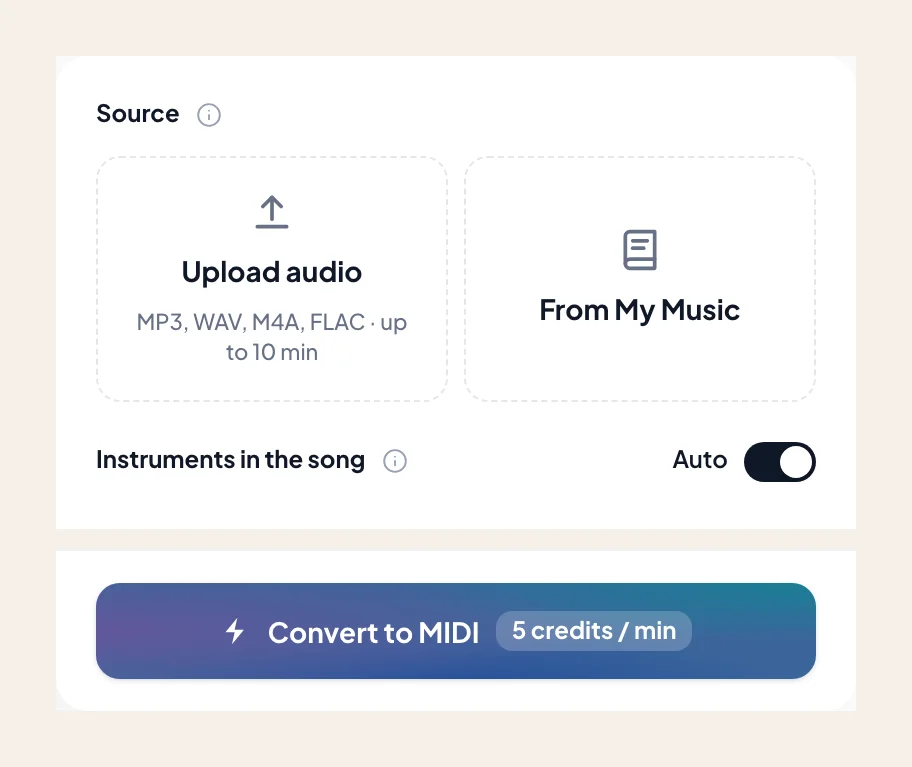
Upload up to 10 minutes of audio
Drop an MP3, WAV, M4A, or FLAC — a modal jazz quartet recording, a smooth-jazz chorus hook, or an isolated horn booth take. Or choose a track from My Music.
- 2
Keep soprano sax selected
Soprano sax is preselected on this landing. Leave it solo so the model ignores comping piano, guitar, or lower horn section voices.
- 3
Verify scoops and fast modal runs on the piano roll
Scrub through grace-note scoops and chromatic turns against the audio to make sure pitch bends settled on the intended target note.
- 4
Export .mid and shape breath expression in your DAW
Download the .mid into Ableton, Logic, Cubase, or FL Studio to re-voice horn sections, double with synth leads, or drive physical-modeling sax plugins.
Soprano sax MIDI ready for horn arrangement and modeling plugins
Export the unquantized .mid straight into your session. If you want a printable Bb transposed lead sheet, switch to the Audio to Sheet Music soprano sax page.
- 01
Unquantized Transcription MIDI (.mid)
Captures laid-back jazz pocket timing, rapid chromatic bebop cells, and expressive phrase endings in concert sounding pitch.
- 02
Built for Physical Modeling & Horn Section Libraries
Drop onto SWAM Soprano Sax, Kontakt horn patches, or fusion synth doubles in Logic, Ableton, Cubase, or Pro Tools.
Cleaner horn isolation gives you tighter soprano sax MIDI
Soprano sax shares frequency territory with trumpeters, female vocals, and high guitar leads.
Split dense jazz-fusion mixes with Stem Splitter first
If an overdriven guitar or synth lead plays unison with the soprano sax, isolate the wind/horn stem first so guitar distortion harmonics don't clutter the roll.
Remember concert pitch vs Bb horn transposition
Your downloaded .mid is always in concert (sounding) pitch so virtual instruments play in key immediately. Only transpose up a major second (+2 semitones) if you are printing a written part for a live Bb saxophonist.
Trim micro-scoop grace notes when driving sample libraries
Deep jazz lip scoops sometimes transcribe as a quick semitone grace note before the main pitch. Merge those into a pitch-bend wheel curve in your DAW for ultra-smooth virtual sax playback.
Jazz producers and horn arrangers working with soprano sax MIDI
“Soprano sax in the upper register sounds so close to an oboe or English horn that generic converters always choke. This hard mask locked right onto my straight-horn solo.”
“I needed just the soprano lead from a big-band sax soli where five horns were playing block chords. Using the soprano-only mask instead of the combined alto page saved me hours of voice separation.”
“Exported the unquantized .mid from a 1970s fusion cut, dropped it onto SWAM Soprano Sax in Logic, and drew in my breath controller curve. The rhythmic swing was already 100% there.”
More saxophones and woodwind leads as MIDI
Explore sibling horns and woodwinds — each page opens Audio to MIDI with that instrument preselected.

Flute
Convert a song or MP3 to flute MIDI online. Capture an exposed flute line as a .mid — keep flute selected, then rewrite phrasing in your DAW.
Clarinet
Convert a song or MP3 to clarinet MIDI online. Capture a clarinet solo line as a .mid — keep clarinet selected, then rewrite in your DAW.
Soprano & alto sax
Convert a song or MP3 to alto or soprano sax MIDI online. Capture the sax melody as a .mid — keep alto / soprano sax selected, then rewrite in your DAW.
Frequently asked questions
Does Song to Soprano Sax MIDI give accurate results?
How do I use Song to Soprano Sax MIDI?
Why should I use the Soprano Sax page instead of the combined Soprano & Alto Sax page?
Can the model tell soprano sax apart from an oboe or clarinet in the same register?
Are the MIDI notes exported in concert pitch or Bb saxophone pitch?
How do jazz pitch scoops and vibrato translate into the MIDI file?
Where do I get a printable Bb transposed lead sheet for soprano sax?
Can I try Song to Soprano Sax MIDI for free?
What do I get after conversion?
Can I open the result in my music software?
Can I use the result in my own projects and commercially?
What files can I upload?
How do I get the best result from Song to Soprano Sax MIDI?

Convert your song to soprano sax MIDI
Upload your recording, keep soprano sax selected, and download an expressive .mid for your DAW.